Mudassir Ali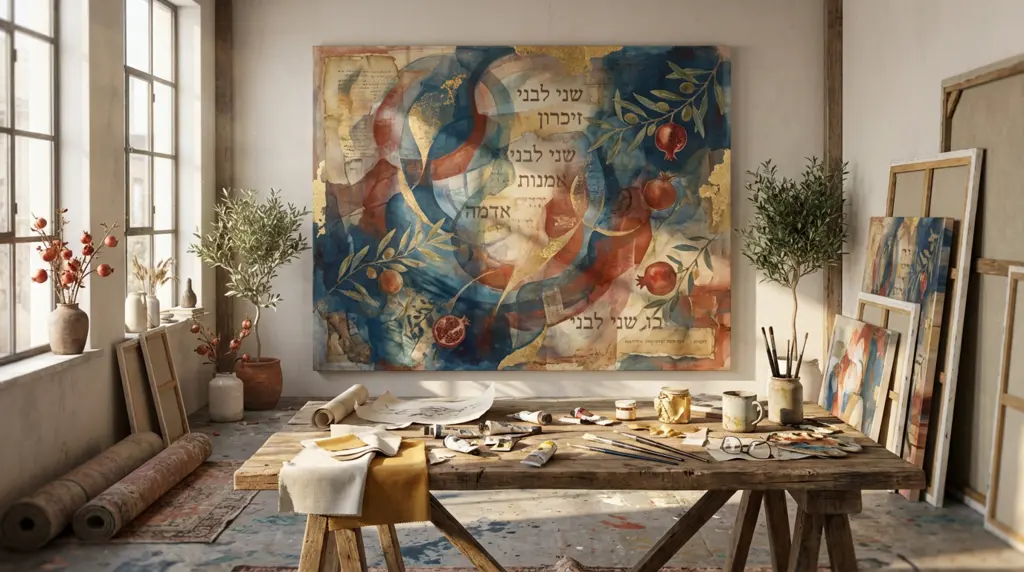
Shani Levni is an Israeli visual artist born and raised in Tel Aviv whose work explores collective memory, Jewish identity, and the emotional weight of displacement through richly layered mixed media compositions. Working across painting, installation, and community art, Levni has built a practice that operates simultaneously in gallery spaces and social contexts, making her one of the more distinctive voices in contemporary Israeli art. Understanding who Shani Levni is and what drives her work requires looking at both the biographical foundations she brings to the canvas and the cultural questions her art refuses to leave unanswered.
Early Life and Cultural Roots
Shani Levni grew up in Tel Aviv surrounded by a family heritage that drew from Jewish, Middle Eastern, and European traditions. That layered background gave her an early sensitivity to how multiple histories can exist within a single identity, a theme that would later define her mature artistic voice. She has described her childhood home as a space full of music, stories, and religious ritual, and those sensory memories appear repeatedly in the visual language of her work.
Tel Aviv’s particular energy, where ancient cultural codes press against contemporary urban life, shaped how Levni learned to look at contradiction. Rather than resolving tensions between tradition and modernity, she learned to hold them both on the canvas at once, which is precisely what her compositions do at their most compelling.
Education at Bezalel and Berlin
Levni completed her undergraduate studies at the Bezalel Academy of Arts and Design in Jerusalem, one of the oldest and most respected art institutions in Israel. There she developed her foundational approach to abstraction and began experimenting with the relationship between color, texture, and cultural memory. Her professors noted her unusual ability to merge emotional intensity with careful formal control, qualities that would define her subsequent work.
She later pursued an MFA in Art Theory in Berlin, where she wrote a thesis titled “Memory as Material” that examined how collective trauma can be made visible through layered surfaces, fragmented text, and deliberate silences in composition. The Berlin years gave her both a theoretical framework and a productive distance from her Israeli context, allowing her to examine Jewish identity and diaspora from an outside vantage point. That dual perspective, inside and outside simultaneously, became one of her signature artistic positions.
Artistic Style and Visual Language
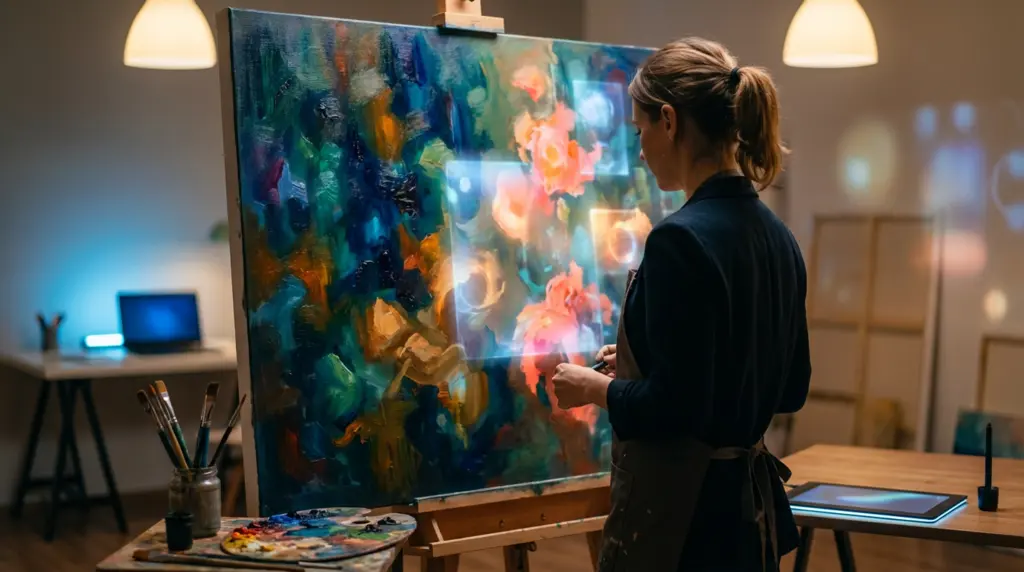
Shani Levni’s work is built on density and concealment. Her canvases typically involve multiple layers of fabric, paper, and paint applied over extended periods, so that traces of earlier marks remain visible beneath the surface, much like the way personal and collective histories persist beneath the present moment. Erased fragments of Hebrew text, partial symbols, and near-hidden imagery invite viewers to look closely rather than read quickly.
Her color choices carry consistent symbolic weight. Deep blues reference the Mediterranean Sea and the sky above Jerusalem. Earthy reds recall ancient ceramics and the soils of the region. Gold leaf appears in works that deal with sacredness or transcendence. Recurring symbols including olive branches, pomegranates, and scrolls function as a private visual language that rewards familiarity across her body of work. The pomegranate appears in many pieces as a symbol of memory and tradition, while the olive branch carries both its universal peace associations and a specifically regional rootedness.
Notable Exhibitions and Works
One of Levni’s most discussed early works, “Whispers of the Olive Tree” from 2018, was shown at the Tel Aviv Museum of Art. The large canvas featured olive branches woven through translucent layers of Hebrew letterforms, and critics praised its ability to hold political implication and personal tenderness in the same visual field.
At the Jerusalem Biennale, Levni presented “Letters Never Sent,” an installation that suspended dozens of handwritten paper scrolls from the ceiling, each containing collected testimonies from displaced individuals. Visitors moved through the hanging scrolls rather than observing them from a distance, which transformed the experience from viewing to inhabiting. The installation drew significant attention for its ability to make abstract themes of displacement physically felt.
Her solo exhibition “Between Earth and Sky” at Rosenfeld Gallery in 2020 continued her exploration of belonging, using raw textures alongside luminous color to suggest resilience after rupture. She also participated in the Berlin Collective Showcase in 2021 and contributed a mural to the Jaffa Refugee Center in 2022, a project that extended her practice well beyond conventional gallery spaces.
The Root Collective and Community Work
Shani Levni founded The Root Collective, a nonprofit organization that runs art workshops for refugees and immigrant youth across Europe and the Middle East. The organization has conducted over 28 workshops in five countries, engaging more than 600 young participants and producing 12 public murals in shared community spaces as of 2023.
Her approach to teaching reflects the same principles that organize her studio work. Participants are encouraged to transform personal narratives into visual forms, and the process of making is treated as emotionally significant rather than purely technical. The Root Collective has become an important part of her identity as an artist, demonstrating that her interest in memory and displacement is not only aesthetic but genuinely practical and social.
Public Voice and Thought Leadership
Beyond her studio and nonprofit work, Shani Levni has spoken at TEDx Jaffa, participated in UNESCO Culture and Healing panels, and contributed to the Berlin Biennale Symposium. Her public statements consistently return to the idea that art carries moral weight and that the artist’s role is not to decorate reality but to challenge it.
Her works are held in private and institutional collections including the Jewish Museum Berlin and the Tel Aviv University Art Archives. She is developing a documentary scheduled for release in late 2026 that follows The Root Collective’s community projects across refugee centers, aiming to show how artistic expression functions as a universal language for processing trauma and building connection. Readers exploring contemporary art and cultural advocacy will find her evolving body of work covered regularly on buzzovia.com alongside similar profiles in modern art and identity.
Why Shani Levni’s Work Matters
Shani Levni’s significance rests on her refusal to separate personal biography from artistic practice or artistic practice from social responsibility. Her compositions are formally sophisticated and emotionally serious, but they also feed directly into community work that produces real outcomes for real people. That combination, studio rigor alongside genuine advocacy, is relatively rare and gives her work a credibility that purely aesthetic or purely activist practices often lack on their own.
Her treatment of Jewish identity and diaspora also addresses questions that remain genuinely unresolved in contemporary culture, questions about where people belong, what history asks of the living, and whether beauty can be an adequate response to suffering. Levni does not answer those questions so much as she holds them open with unusual care.
Frequently Asked Questions
Who is Shani Levni? Shani Levni is an Israeli visual artist born in Tel Aviv who works in mixed media, abstract painting, and installation art. She studied at the Bezalel Academy of Arts and Design in Jerusalem and completed an MFA in Art Theory in Berlin. Her work addresses themes of identity, memory, and displacement.
What is Shani Levni known for? Shani Levni is known for her densely layered mixed media paintings that incorporate fragments of text, fabric, and symbolic imagery drawn from Jewish and Mediterranean traditions. She is also known for founding The Root Collective, a nonprofit that runs art workshops for refugees and immigrant youth.
Where has Shani Levni exhibited? Shani Levni has exhibited at the Tel Aviv Museum of Art, the Jerusalem Biennale, and Rosenfeld Gallery, among other venues. She also participated in the Berlin Collective Showcase and contributed to the Jaffa Refugee Center mural project.
What themes does Shani Levni explore in her art? Her work focuses on collective memory, Jewish identity, diaspora, spiritual belonging, and the visual language of cultural trauma. Recurring symbols in her paintings include olive branches, pomegranates, and fragments of Hebrew text.
What is The Root Collective? The Root Collective is a nonprofit organization founded by Shani Levni that provides art workshops for refugees and immigrant youth in Europe and the Middle East. By 2023 it had run more than 28 workshops in five countries and engaged over 600 young participants.
Is Shani Levni the same as the digital leadership figure described on other websites? No. Several websites describe a “Shani Levni” as a vague digital strategist or tech leader with no verifiable details. The factually documented Shani Levni is an Israeli visual artist with a confirmed biographical record, academic credentials from Bezalel Academy and Berlin, and exhibition history at established art institutions.
Conclusion
Shani Levni continues to grow as both a visual artist and a social advocate whose layered compositions and community-driven projects have earned her a lasting place in contemporary art. Her ability to translate collective memory into physical form, and to carry that sensitivity directly into the lives of displaced communities through The Root Collective, makes her practice unusually coherent across its different modes. Whether encountered in a gallery, a refugee center workshop, or a public symposium, her work pursues the same essential question: how do we hold onto who we are when history keeps asking us to let go.


 Rizwan Ali