News
Israel Iran War 2026: What’s Happening and What’s Next

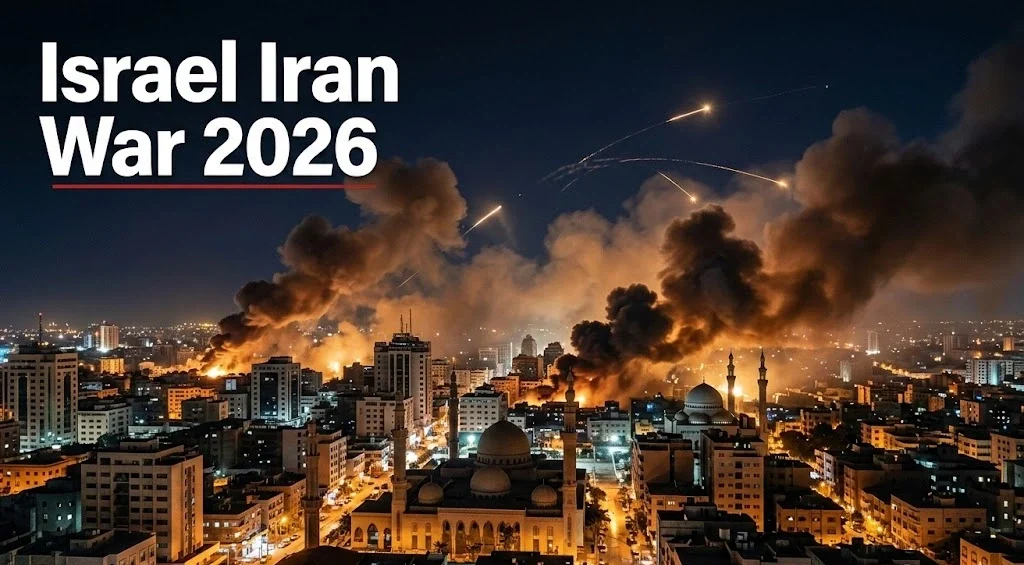
You checked your phone Saturday morning and the world looked completely different. Beginning on February 28, 2026, Israel and the United States launched coordinated joint attacks on multiple sites across Iran — codenamed Operation Roaring Lion by Israel and Operation Epic Fury by the United States. Wikipedia Within hours, the Middle East was in open war. And if you’re an American wondering what this means for you, your wallet, and the world — you’re not alone.
This is the Israel Iran war explained clearly, without the spin.
How the Israel Iran War Started
The conflict didn’t come out of nowhere. Tensions between Iran and the United States over Iran’s nuclear program began intensifying in January 2026, as the US amassed air and naval assets in the region at a level not seen since the 2003 invasion of Iraq. Wikipedia
On February 25, Iranian Foreign Minister Abbas Araghchi said a “historic opportunity” for a nuclear agreement was “within reach,” with talks scheduled in Geneva. But a third round of indirect negotiations on February 26 showed the two sides remained far apart. Wikipedia Trump had issued a 10-day ultimatum for a deal. When talks collapsed, strikes began.
The operation targeted key Iranian officials, military commanders, and facilities — with the stated aim of regime change. It began with joint strikes on Tehran, Isfahan, Qom, Karaj, and Kermanshah, and included the assassination of Supreme Leader Ali Khamenei. Wikipedia
Iran declared 40 days of mourning following Khamenei’s killing Al Jazeera and immediately launched retaliatory strikes.
The Scale of Fighting — By the Numbers
This is one of the most intense military campaigns in modern Middle Eastern history. Around 2,000 strikes were conducted by Israel and the US through March 1 alone. House of Commons Library
Iran’s air force dropped more than 1,200 munitions across 24 of Iran’s 31 provinces in a single day. Iran’s IRGC launched attacks on 27 US military bases across the Middle East, plus Israeli military facilities in Tel Aviv and other cities. Al Jazeera
The human cost is already devastating. Preliminary figures show at least 787 dead in Iran, at least 11 in Israel, six US soldiers killed, and eight civilians dead in Gulf states. Al Jazeera
Iran targeted the US Navy’s 5th Fleet headquarters in Bahrain, Bahrain’s international airport, and several residential buildings in Manama. At least 40 buildings in Tel Aviv were damaged in Iranian strikes on February 28. Al Jazeera
What This War Means for Your Gas Prices
Here’s where the Israel Iran war hits home for most Americans — at the pump.
The Strait of Hormuz carries roughly 30% of the world’s seaborne crude oil. Nearly 20% of global jet fuel and about 16% of gasoline also flows through this narrow waterway. Al Jazeera
An IRGC commander declared the strait “closed,” warning any vessel attempting to pass would be set “ablaze.” At least five tankers have been damaged, two personnel killed, and around 150 ships stranded on either side of the strait. Al Jazeera
Before this conflict, US gasoline was projected to average $2.90 per gallon in 2026. Experts now warn the national average could spike to $3.50 per gallon by the summer driving season. FinancialContent
US crude jumped 7.5% when markets opened Monday. Brent crude briefly surpassed $82 per barrel. CNN If the disruption holds, Goldman Sachs has previously estimated oil could push past $100 a barrel.
It takes roughly six weeks for crude oil to be processed and delivered as gasoline, so some of the price pain may be slightly delayed — but with supply already constrained, Americans are likely to see effects at the pump soon. CNBC
Regional Fallout: Who Else Is Getting Pulled In
The Israel Iran war isn’t staying contained to two countries.
Iran launched missiles and drones at Israel and Gulf countries hosting US military bases — including the UAE, Qatar, Kuwait, and Saudi Arabia. Civilian infrastructure was also hit, including Dubai’s Fairmont The Palm hotel. CNBC
Qatar says it downed Iranian missiles targeting its airport. Kuwait intercepted several ballistic missiles. Jordan’s armed forces intercepted 49 drones and missiles that entered its airspace. Al Jazeera
The US Embassy in Riyadh was also struck by drones. CNBC Flight cancellations spread globally as airlines pulled back from the region.
On the diplomatic side, Western nations largely backed Trump — Australia and Canada both issued statements supporting US action to prevent Iran from acquiring nuclear weapons. China and Russia condemned the strikes. CNBC
Netanyahu told Fox News this conflict “will usher in an era of peace,” claiming it will allow the Iranian people to form a democratically elected government. Critics, including US Senator Chris Murphy, fired back that the administration “has no plan for the chaos unfolding in the Middle East.” CNN
How Long Could This Last?
Trump himself predicted a relatively short war. He stated that attacks on Iran would continue until all objectives are met, Al Jazeera and has suggested the conflict could last four to five weeks.
Oxford Economics analysts assessed that Iran cannot win militarily, but that disrupting Gulf oil flows could inflict serious economic damage. Their base case: the conflict will not last beyond two months. Oxford Economics
The conflict is already having unprecedented effects on global gas markets — with LNG flows through the Strait of Hormuz halted, Israeli gas fields shut down, and Iranian pipeline exports threatened, the disruption could amount to around 130 billion cubic meters on an annualized basis. Columbia University
What happens after the fighting stops matters just as much as the war itself. A power vacuum in Iran, uncertainty over nuclear facilities, and a fractured Gulf energy market will define the next chapter — regardless of who declares victory.
What Americans Should Watch Right Now
- Gas prices — expect movement within weeks if the Strait of Hormuz remains disrupted
- Stock markets — defense stocks are rising; broader indices are under pressure
- Federal Reserve — rate cut expectations for March 2026 have collapsed to near zero following the oil price spike FinancialContent
- Iran’s leadership transition — with Khamenei gone, who fills the vacuum shapes everything that follows
- Diplomatic signals — any ceasefire talk will move oil markets instantly
The Israel Iran war is the most consequential Middle East conflict in a generation. Whether it ends in weeks or drags on, the economic and geopolitical effects will reach every American household — from the gas station to the grocery store.
Stay informed. Understand what’s at stake. And keep watching the Strait.


-
 Blog6 months ago
How Much Does It Cost to Rent a Porta Potty? (2026 Pricing Guide)
-
Lifestyle8 months ago
The Ultimate Guide to Choosing Contact Lenses for Beginners
-
Lifestyle7 months ago
Babydollkaila: The Alt-Fashion Icon Redefining Digital Style
-
Blog6 months ago
Common Questions About Workplace Rights
-
News9 months ago
Is Debby Clarke Belichick Still Alive? 2025 Update & Truth
-
News9 months ago
Hong Kong Fire: The Tragedy That Shook a City
-
Uncategorized7 months ago
Healthy Habits for Supporting Women’s Hair Wellness
-
News8 months ago
Melissa Sinkevics: The Woman Behind the Pageant Crown