Automotive
How Much Automatic Transmission Fluid to Add — Full Guide

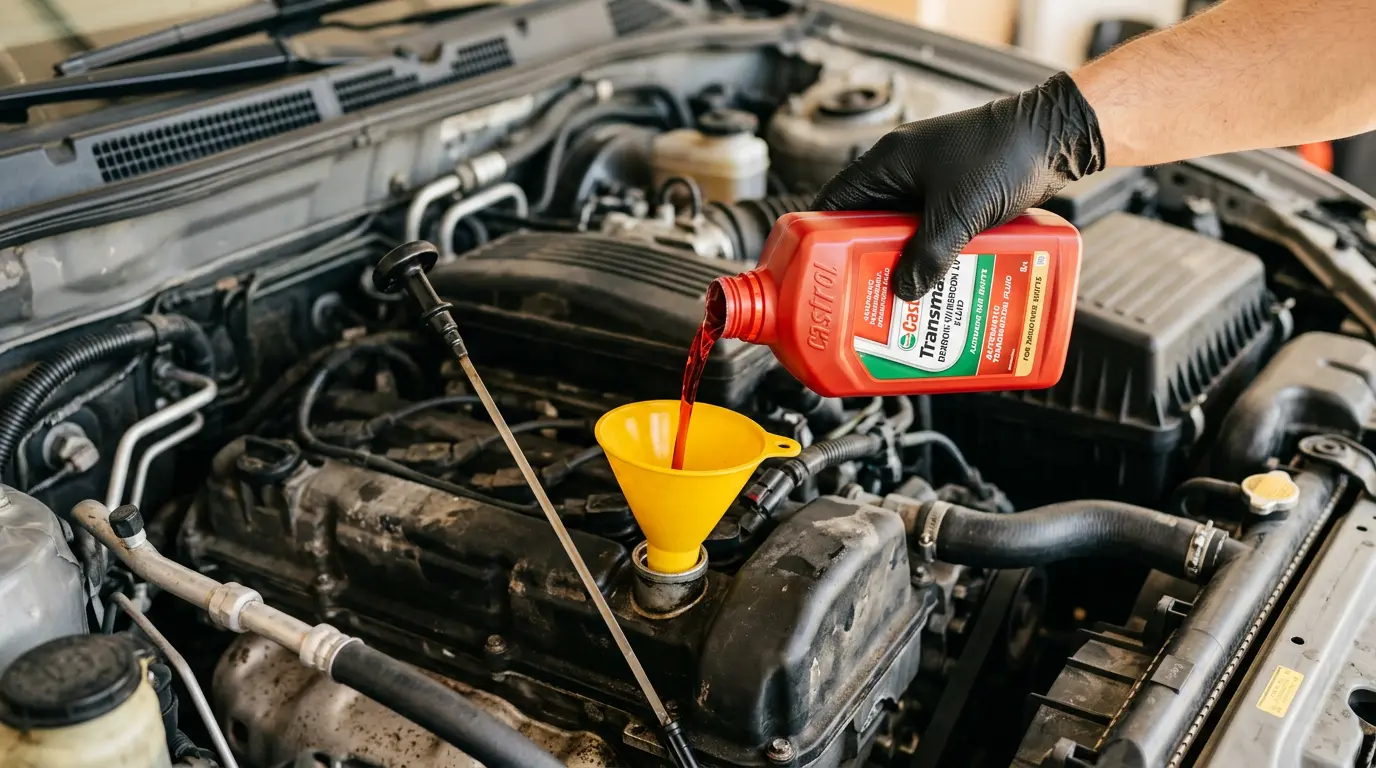
Knowing how much automatic transmission fluid to add depends on one thing: whether you are topping off a low level, doing a partial drain-and-fill, or refilling a completely dry transmission. For a partial fluid change, most vehicles need 2–6 quarts. For a completely empty transmission, the total capacity is typically 12–16 quarts depending on the vehicle. Adding the right amount — not too much, not too little — is the difference between a smooth-shifting gearbox and one that is either starved of lubrication or foaming from overpressure. This guide walks through exact amounts, how to read the dipstick correctly, which fluid type your vehicle needs, and what happens when you get the amount wrong.
How Much Fluid to Add Based on Your Situation
The amount of automatic transmission fluid your car needs depends entirely on the situation you are dealing with.
If your dipstick shows the fluid level is slightly low, you only need to bring it back up to the full mark. That typically means adding between half a quart and one quart. Never add more than one quart at a time without rechecking the level, because the difference between the low mark and the full mark on most automatic transmission dipsticks represents only about one quart of fluid.
If you are performing a drain-and-fill service — draining the transmission pan, replacing the filter if applicable, and refilling — expect to use 4–6 quarts for most passenger vehicles. A drain-and-fill does not remove all the fluid in the system because the torque converter retains fluid that does not drain from the pan. This is why a partial service only replaces roughly a third to half of the total system capacity.
If the transmission is completely dry — following a rebuild, a replacement, or a full flush that evacuated the torque converter — you are looking at 12–16 quarts for most modern automatic transmissions. Always check your vehicle’s owner manual or the OEM service specification for the exact capacity, because this range varies considerably across different makes and models.
Transmission Fluid Capacity by Vehicle Type
Knowing the general capacity range for your vehicle type prevents guessing and over-purchasing before you start.
| Vehicle Type | Drain-and-Fill Amount | Full System Capacity |
|---|---|---|
| Compact sedan (e.g., Honda Civic, Toyota Corolla) | 3–4 quarts | 7–9 quarts |
| Mid-size sedan (e.g., Camry, Accord) | 4–5 quarts | 9–11 quarts |
| Full-size sedan / V6 (e.g., Charger, Avalon) | 5–6 quarts | 11–13 quarts |
| Light truck / SUV (e.g., F-150, Tahoe, Silverado) | 5–7 quarts | 12–16 quarts |
| Heavy-duty truck (e.g., F-250, Ram 2500) | 6–8 quarts | 14–18 quarts |
These are baseline estimates. Always verify against your owner manual or an OEM-specific service guide before purchasing fluid — being one quart short is far less damaging than overfilling.
How to Check the Transmission Fluid Level Correctly
Checking the transmission fluid level incorrectly gives you a false reading, which is one of the most common reasons people add the wrong amount.
For most vehicles with a traditional dipstick, the check must be done with the engine warm and running, the vehicle on a level surface, and the transmission cycled through all gear positions by moving the selector from Park through each position and back to Park before checking. This matters because the fluid expands as it warms and distributes through the system as gears are engaged. Checking cold gives a falsely low reading.
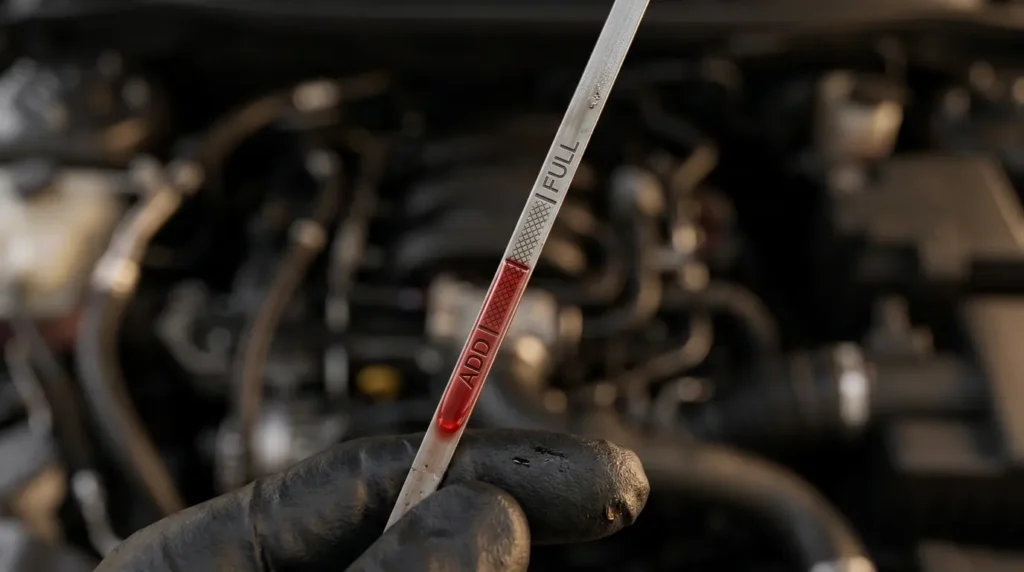
Pull the dipstick out, wipe it clean with a lint-free cloth, reinsert it fully, then pull it out again and read it. The fluid level should fall between the two marks — usually labeled “Min/Max,” “Add/Full,” or “Cold/Hot” depending on the vehicle. If the level sits at or below the lower mark, add fluid in half-quart increments, rechecking between each addition.
For sealed transmissions — increasingly common on vehicles from Honda, Ford, BMW, and others since around 2010 — there is no traditional dipstick. These transmissions require checking through a fill plug on the side of the transmission case, usually requiring the vehicle to be raised on a lift and the fluid to be at a specific temperature window (typically 95–115°F or 35–45°C) to get an accurate reading. If your vehicle has a sealed transmission, checking and adding fluid yourself without the proper tools is not recommended. A shop visit is the reliable path.
Which Automatic Transmission Fluid Type to Use
Adding the right amount of fluid means nothing if you add the wrong type. Automatic transmission fluid specifications are not interchangeable between manufacturers, and using an incorrect spec can cause seal degradation, clutch pack damage, and erratic shifting over time.
Dexron VI is the current General Motors specification covering most GM vehicles built from 2006 onward. It backward-compatible with older Dexron III applications. Mercon V and Mercon LV are the Ford specifications, with LV being required for many newer Ford transmissions — the two are not interchangeable despite sharing the name. Toyota uses ATF Type T (multiple variants including T-IV and WS), and Honda specifies its own Z-1 or DW-1 fluid for most applications. Chrysler uses ATF+4 across most of its rear-wheel-drive and four-wheel-drive applications.
The fastest way to confirm the correct specification for your vehicle is to open the owner’s manual and check the transmission fluid section, or look directly at the transmission dipstick — many manufacturers print the required spec on the dipstick handle. Using a universal multi-vehicle ATF is acceptable only if the product is explicitly certified to meet your vehicle’s OEM specification, and that certification should be confirmed on the product label rather than assumed from the word “universal.”
What Happens If You Add Too Much Transmission Fluid
Overfilling the transmission is a genuine mechanical risk and more common than most drivers expect, because the margins between the low and full marks on the dipstick are narrow.
When the fluid level is too high, the spinning components inside the transmission churn the excess fluid into foam. Foamed fluid compresses, whereas normal liquid does not, which means the hydraulic pressure that controls gear changes becomes erratic. Shifts become harsh, late, or intermittent. The aeration also reduces the fluid’s lubrication and cooling capacity, which accelerates wear on clutch packs and bearings.
Sustained overfilling increases internal pressure enough to push fluid past seals, causing external leaks from the transmission pan gasket, axle seals, or dipstick tube. These leaks are often misidentified as indicating that the transmission needs more fluid — which makes the overfill worse if the driver responds by adding more. If you notice red fluid on the driveway after recently adding fluid, check the dipstick level before adding anything. The leak may be pressure-caused rather than depletion-caused.
The fix for an overfill is to drain a measured amount through the drain plug, then recheck the level. There is no shortcut to correcting this correctly.
Signs Your Transmission Fluid Is Low Right Now
Recognizing low fluid symptoms before they cause internal damage is worth knowing alongside the volume questions.
Delayed or sluggish engagement when shifting from Park into Drive or Reverse is typically the first sign. If the transmission takes more than a second or two to engage after moving the selector, the hydraulic pressure that applies the clutches is not building fast enough, which low fluid directly causes. Gear slipping during normal driving — where the engine revs but the vehicle does not accelerate proportionally — follows the same root cause.
Whining or humming noises at highway speed, particularly noises that change pitch with vehicle speed rather than engine speed, often point to a torque converter or pump working without adequate fluid. A burning smell from the transmission area indicates that friction surfaces are running without adequate lubrication, which damages components quickly. Any combination of these symptoms warrants an immediate fluid level check before driving further. For broader coverage of transmission maintenance and other drivetrain topics, buzzovia.com covers these in its automotive guides section.
How Often to Change Automatic Transmission Fluid
Adding fluid and changing fluid are different services, and knowing when each is needed prevents unnecessary expense.
Most manufacturers specify a transmission fluid change interval of 30,000–60,000 miles under normal driving conditions. Severe duty driving — frequent towing, stop-and-go city driving, mountainous terrain, or extended operation in extreme heat — shortens this interval to 15,000–30,000 miles. Some manufacturers, particularly for newer sealed transmissions, specify “lifetime” fluid that theoretically never needs changing. Many professional transmission specialists consider that designation optimistic and recommend inspecting sealed transmission fluid at around 60,000–80,000 miles regardless.
The color and smell of the fluid on the dipstick is the most practical field indicator. Fresh ATF is transparent red with a mild petroleum smell. Fluid that has degraded looks dark brown or black and smells burnt. If the fluid on the dipstick looks or smells burnt, a drain-and-fill or full flush is warranted regardless of mileage.
Frequently Asked Questions
How much automatic transmission fluid to add if it reads low on the dipstick? If the dipstick reads between the Add and Full marks, add fluid in half-quart increments and recheck after each addition. The difference between the low and full marks typically represents about one quart, so rarely will you need more than one quart to bring the level back to the full mark.
Can I add transmission fluid myself? Yes, for vehicles with a traditional dipstick and accessible fill tube, adding ATF is a straightforward task. Use a small funnel, add in half-quart increments, and recheck the level on the dipstick each time. For sealed transmissions without a dipstick, professional service is recommended.
What happens if I mix different ATF types? Mixing ATF specifications is not recommended and can cause foaming, reduced lubrication, and seal damage over time. If you have added a mismatched fluid, a drain-and-fill service with the correct spec fluid is the appropriate correction. A single instance of mixing is unlikely to cause immediate damage but should be corrected at the next service.
How do I know if my car has a sealed transmission? If you cannot find a transmission dipstick after checking the owner’s manual and visually inspecting the engine bay, the vehicle likely has a sealed transmission. Common examples include post-2011 Honda vehicles, many BMW models, and several Ford models. The owner’s manual will confirm this.
Why is my transmission fluid level low if there are no visible leaks? Transmission fluid does not burn off during normal operation the way engine oil does. A low level with no external leak usually means an internal seal has failed and fluid is leaking into the engine or torque converter. Have the transmission inspected professionally before simply adding fluid and driving on.
How much ATF does a full flush take compared to a drain-and-fill? A drain-and-fill removes 4–6 quarts from most passenger vehicles and replaces only the fluid in the pan. A full flush uses a machine to exchange all fluid including the torque converter, which removes and replaces 12–16 quarts in most vehicles. A flush is more thorough but also more expensive and is generally not recommended for high-mileage transmissions that have been running degraded fluid for extended periods.
Conclusion
The right amount of automatic transmission fluid to add is 2–6 quarts for a partial drain-and-fill, half a quart to one quart for a low-level top-off, and 12–16 quarts for a completely dry transmission. Always add in small increments and verify the dipstick reading between each addition — the dipstick margin between low and full is narrow, and overfilling causes as much damage as running low. Use the correct OEM-specified fluid type for your vehicle, check the level with the engine warm and running on level ground, and treat a persistently low level as a leak symptom worth investigating rather than just a maintenance task to repeat.


-
 Blog7 months ago
How Much Does It Cost to Rent a Porta Potty? (2026 Pricing Guide)
-
Lifestyle9 months ago
The Ultimate Guide to Choosing Contact Lenses for Beginners
-
Lifestyle8 months ago
Babydollkaila: The Alt-Fashion Icon Redefining Digital Style
-
Blog7 months ago
Common Questions About Workplace Rights
-
News10 months ago
Hong Kong Fire: The Tragedy That Shook a City
-
News9 months ago
Is Debby Clarke Belichick Still Alive? 2025 Update & Truth
-
Uncategorized8 months ago
Healthy Habits for Supporting Women’s Hair Wellness
-
News9 months ago
Melissa Sinkevics: The Woman Behind the Pageant Crown